
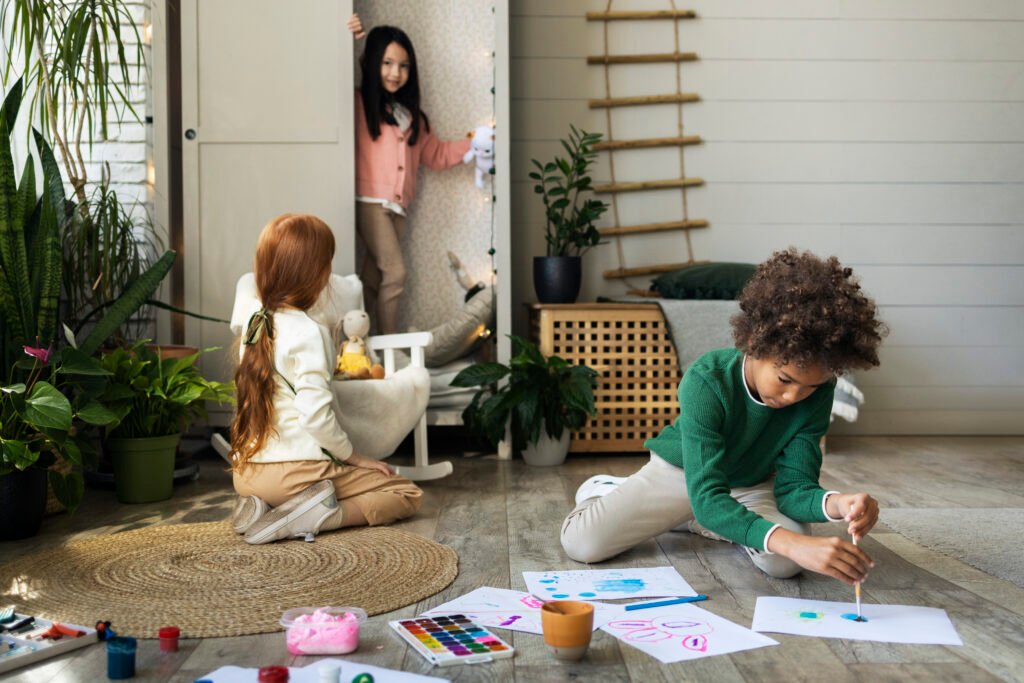
There is a particular kind of magic that belongs to summer holidays — the feeling of waking up without an alarm, with nowhere you absolutely have to be and nothing you absolutely have to do. Children know this feeling instinctively, and they are wired to use that freedom well. The problem, in the modern home, is that without a little creative infrastructure, that freedom tends to collapse into screen time, boredom complaints, and the slow dread of six weeks slipping by unspent.
The good news is that the most memorable summers are almost never the most expensive ones. The activities that children genuinely remember — and that genuinely develop them — tend to involve their hands, their imaginations, their bodies, and other people. This guide brings together a rich collection of low-cost, high-engagement summer activities for children of all ages. Some are messy. Some are noisy. All of them are worth it.
First: Give Boredom a Chance
Before launching into activities, here is a counterintuitive piece of advice: let your child be bored. Not indefinitely, not without resources — but for long enough to feel the productive discomfort that precedes genuine creativity. Research on children’s play consistently shows that unstructured time is where the most creative and imaginative play emerges. The child who says “I’m bored” and is left to sit with it for twenty minutes will almost always invent something more interesting than anything an adult could have scheduled.
The Best school in Electronic City — where children engage with structured and self-directed learning throughout the term — understands this deeply. Structured programming is balanced with genuine free time precisely because educators know that self-directed exploration produces a different kind of learning: one driven by curiosity, personal interest, and intrinsic motivation. Parents can apply the same wisdom at home.
Creative Arts and Craft Activities
Tie-Dye Everything
Tie-dye is a summer ritual that never gets old. Old white T-shirts, a packet of fabric dye, rubber bands, gloves, and a garden — that is all you need. Children learn about colour theory (what happens when blue meets yellow?), develop planning skills (which fold will make which pattern?), and produce wearable art they are genuinely proud of. Set up a “dye station” outdoors and make an afternoon of it.
Nature Printing and Botanical Art
Spend twenty minutes collecting leaves, flowers, feathers, and interesting bark from the garden or a nearby park. Then lay them on paper, place another sheet on top, and rub firmly with the side of a crayon — the hidden details of every leaf’s structure emerge like magic. Arrange pressed leaves into botanical compositions and frame them. This activity costs nothing, produces beautiful results, and teaches children to look at the natural world with genuine attention.
Cardboard City
Ask a supermarket for large cardboard boxes — they are usually given away for free. Then set your child loose with paint, tape, scissors, and markers to build whatever they imagine: a rocket, a shop, a castle, a puppet theatre, a city block. The planning and construction involved in a major cardboard project is serious developmental work — it requires spatial reasoning, problem-solving, persistence, and creativity. And because there is no wrong answer, every child succeeds.
Science and Discovery Activities
Turn the Kitchen into a Laboratory
The kitchen is one of the most underutilised science labs in the world. Non-Newtonian fluid — made by mixing cornflour with water — behaves like a solid when you punch it and a liquid when you rest your hand on it, and it produces the kind of delighted disbelief that no worksheet ever could. Elephant toothpaste, crystal growing, density towers made from oil, water, and food colouring, erupting volcanoes — these experiments teach genuine scientific concepts while feeling like the best kind of magic.
Keep a simple science journal where children record their predictions before each experiment and their observations afterwards. This one habit — writing what you think will happen, then recording what actually does — is the entire scientific method in miniature, and it is a habit that serves children long after summer ends. The Top international school in Bannerghatta Road embeds exactly this kind of inquiry-based thinking into its science curriculum, recognising that children who learn to ask good questions become the best kind of thinkers.
Grow Something
Sunflowers, cherry tomatoes, radishes, mint — these are all fast-growing, forgiving, and deeply satisfying for young gardeners. Repurposed yoghurt pots or tin cans make perfect containers. Give each child their own plant to name, tend, and eventually harvest. The act of growing something — watching a seed split open, a seedling push through soil, a flower turn into a fruit — teaches patience, observation, and the slow satisfaction of caring for something over time. These are qualities that no amount of screen time can build.
Nature Journaling
A nature journal is simply a notebook in which children draw, write, and collect observations about the world outside. What birds visited the garden this week? What does the sky look like at different times of day? What insect did you find under that rock? The Top school in Electronic City integrates outdoor observation into its curriculum precisely because educators know that children who pay attention to the natural world develop the careful, curious, evidence-based thinking that underpins all good learning. A summer of nature journaling is a summer of becoming a better observer of everything.
Physical and Outdoor Activities
Obstacle Course Engineering
The greatest obstacle course is always the one the children design themselves. Give them the brief — must include something to jump over, something to crawl under, something to balance on, and something to throw into — and then let them solve it using what is available: garden furniture, hula hoops, chalk-drawn targets, rope, cushions, buckets. Time with each other. Redesign after every run. An afternoon disappears in the best possible way.
Scavenger Hunts With a Twist
A standard scavenger hunt is fun. A scavenger hunt with a theme is extraordinary. Try a colour hunt (find something in every colour of the rainbow), a texture hunt (rough, smooth, soft, prickly, slimy), a sound hunt (find five things that make a sound), or an alphabet hunt (find something beginning with each letter). For older children, create a mystery narrative and make the hunt a puzzle that unfolds across the day. These variations turn a simple activity into a genuinely absorbing adventure.
Backyard Camping
A tent in the garden — or even a den constructed from bedsheets and garden furniture — creates an adventure that feels genuinely exciting even within the boundaries of home. The experience of sleeping somewhere slightly unfamiliar, cooking simple food outdoors, watching the sky darken and the stars emerge, telling stories by torchlight — these are experiences that lodge themselves permanently in a child’s memory. And they cost almost nothing.
The Best school in Bannerghatta road knows that experiences which build independence, resilience, and a sense of adventure in children don’t have to be elaborate. A backyard camping night is a small, joyful taste of that same spirit — and an experience children will ask to repeat all summer.
Reading and Learning Activities
Build a Summer Reading Challenge
Create a family reading tracker: a simple chart or paper caterpillar that grows one segment for every book completed. Set a goal together, agree on a meaningful celebration when you reach it, and let children choose their books entirely. Autonomy is the point — a child who freely chooses what they read is a child who is developing genuine reading motivation rather than compliance. And the child who reads ten books over summer arrives at school in September with a vocabulary and comprehension advantage that compounds across the entire year.
Cooking as a Learning Experience
Hand a child a simple recipe and the ingredients to make it, and watch what happens. Cooking is simultaneously a reading lesson (following instructions), a maths lesson (measuring, fractions, doubling quantities), a science lesson (why does bread rise?), and a profound life skill. As confidence builds, raise the stakes: let them plan and cook an entire meal for the family. The pride on a child’s face when the people they love eat something they made is one of summer’s most reliable highlights.
Making the Most of Your Community
Summer does not only happen at home. Libraries run reading challenge programmes. Community centres offer low-cost holiday workshops. Parks become outdoor classrooms. Families are encouraged to engage actively with their local community throughout the year — because learning happens everywhere, not just within school walls.
Ask your school what summer resources they recommend. The Top residential school in Bangalore shares curated reading lists, project ideas, and community resources with families at the start of each holiday because educators know that the richest summers make use of all three pillars: school, family, and community. These resources are worth seeking out and using deliberately.
Conclusion
The summer activities that children carry with them into adulthood are rarely the expensive ones. It is the summer when they grew their first tomato. In the afternoon they turned three cardboard boxes into a castle. The night they slept in the garden under actual stars. The week they read a book so good they couldn’t put it down. These experiences are available to every family. They require not money but intention — and the willingness to put down the screen, step outside, and see what happens.
FAQs
1. How do I keep children engaged without relying on screens during summer?
Rotate across categories — creative, physical, scientific, culinary, and reading activities — to maintain novelty. Involve children in planning their own days. Keep a basket of basic materials accessible for self-initiated making. And protect genuine boredom time: the best ideas come from children who are left to solve the problem of having nothing to do.
2. What are the best low-cost activities for young children aged three to seven?
Water and sand play, homemade playdough, nature walks and collections, simple kitchen science experiments, painting and printing, obstacle courses, and reading aloud together are all highly engaging, developmentally rich, and almost free. Young children do not need elaborate activities — they need time, space, and basic materials.
3. How do I balance structure and free time over summer?
A light daily rhythm works better than either rigid scheduling or total formlessness. Anchor points — a morning outdoor period, a reading time after lunch, a creative activity in the afternoon — provide enough structure to prevent the drift that leads to screen dependence, while leaving large blocks of genuinely free, child-directed time within which creativity can flourish.
4. How can I prevent summer learning loss without making it feel like school?
Reading for pleasure is the single most effective protection against summer learning loss. Cooking (maths and literacy), nature observation (science), travel conversations (geography and history), and family discussions about current events all build knowledge naturally. Keep any formal academic practice brief, optional, and framed positively.
5. What activities work well for older children and tweens?Older
children thrive on projects with genuine stakes and longer timelines: a photography series, a short film, learning a new instrument or language, writing a blog, building something with their hands, or taking a free online course in a subject they are passionate about. Autonomy, real challenge, and a sense of meaningful accomplishment are what this age group needs — not entertainment.