

Parts of Speech for Kids – 5 Easy Grammar Tricks
Introduction: What Are Parts of Speech and Why Do They Matter?
Imagine building a Lego castle — every piece has a job. Some blocks are walls, some are windows, and some make the roof. In the same way, every word in a sentence has a job too. These jobs are called the parts of speech.
Knowing the parts of speech helps you build strong, correct, and fun sentences. You’ll be able to write cool stories, ace your English tests, and even speak better! No wonder English grammar is an important skill taught in the best ICSE schools in South Bangalore — it helps students become confident writers and speakers for life.
But let’s be honest — grammar can feel boring sometimes. That’s why we’ve made it super easy with colourful tricks, real examples from songs and movies, and fun ways to practice. Let’s turn grammar into something you actually enjoy!
Also Check out the best schools in Bangalore that indulge students in activities that improve time management skills, communication, emotional intelligence, and other essential skills for long-term success.
What are the 8 Parts of Speech?
The English language has eight parts of speech. Each word in a sentence belongs to one of these categories:
Part of Speech | What it Does | Example Words |
Noun | Names a person, place, thing, or idea | book, school, happiness |
Pronoun | Replaces a noun | he, she, it, they |
Verb | Shows action or state | run, jump, is, are |
Adjective | Describes a noun/pronoun | tall, beautiful, red |
Adverb | Describes a verb/adjective/adverb | quickly, very, always |
Preposition | Shows relation/location | on, in, under, over |
Conjunction | Joins words or sentences | and, but, or |
Interjection | Shows emotion | Wow!, Oh!, Oops! |
Real-Life Examples from Songs, Movies & Books
Learning parts of speech gets easier when you connect them with things you love — like songs, movies, or books.
Nouns
“Hakuna Matata” (The Lion King) — “Matata” means “worries” (noun).
Verbs
“Let it Go” (Frozen) — “Let” and “Go” show action (verbs).
Adjectives
“You’re Beautiful” (Song by James Blunt) — “Beautiful” describes a person (adjective).
Adverbs
“Slowly Slowly” (song) — “Slowly” tells how the action happens (adverb).
Prepositions
“Under the Sea” (The Little Mermaid) — “Under” shows location (preposition).
Conjunctions
“Neither snow nor rain…” — “Nor” joins ideas (conjunction).
5 Easy Tricks to Master the Parts of Speech
1. Group Words by Their Job
Every word in a sentence has a job. Some name things (nouns), some show actions (verbs), and some describe things (adjectives). Group them by what they do.
Example:
- Noun: cat, book, teacher
- Verb: run, read, jump
- Adjective: happy, tall, blue
Trick:
Think of words like superheroes — each has a special power!
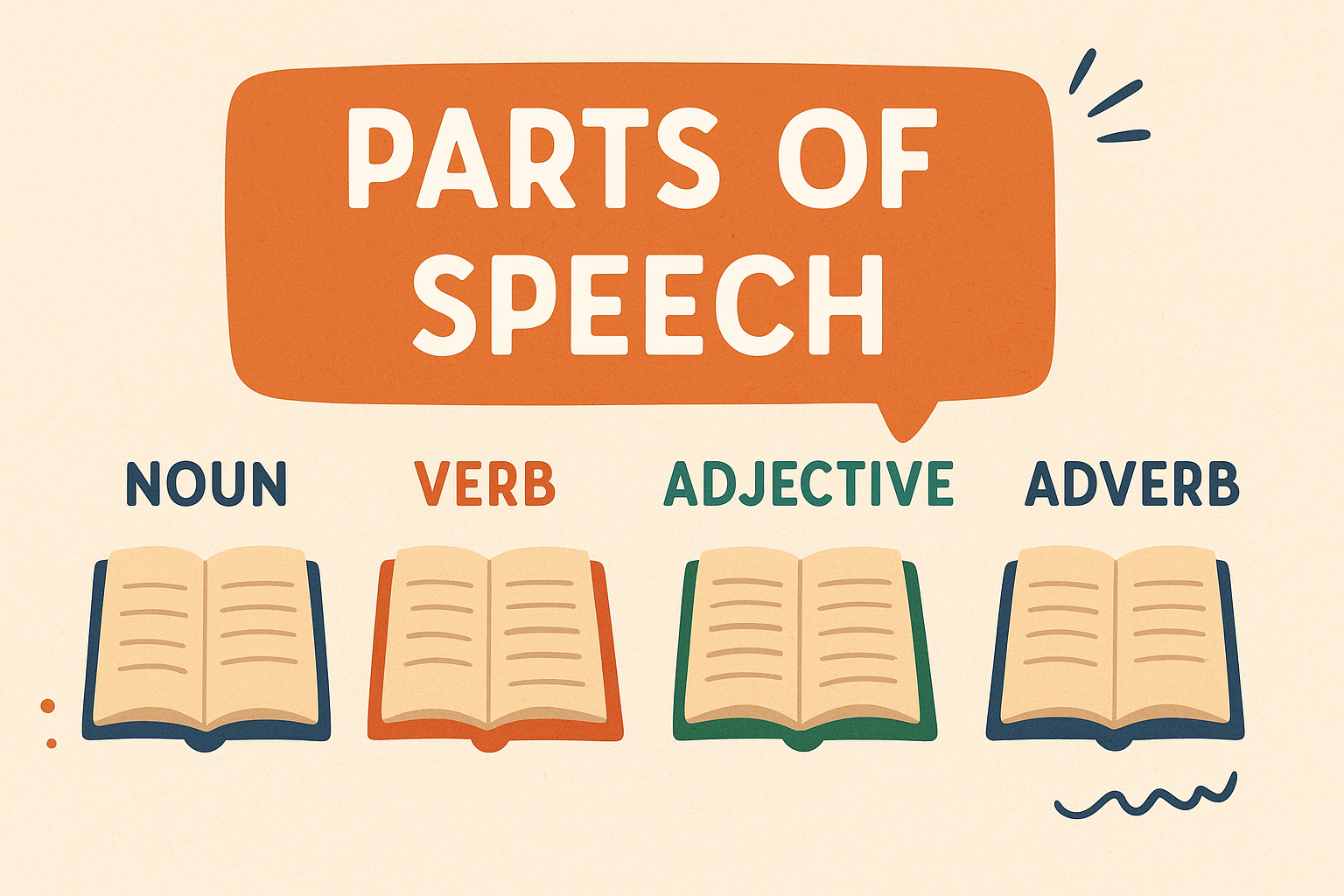
2. Use Colour Coding While Learning
Pick a colour for each part of speech. For example:
Colour | Part of Speech |
Blue | Noun |
Red | Verb |
Green | Adjective |
Yellow | Adverb |
Trick:
Use colour pens or highlighters to mark the words in your homework or storybooks. It makes learning fun and helps you remember better.
3. Make Your Own Grammar Chart
Draw a chart with the 8 parts of speech. Add words and examples for each one.
Trick:
Stick the chart on your wall or notebook cover. Every time you see it, you’ll learn without even trying!
4. Play Grammar Games
Turn grammar into a game! Try matching words with their parts of speech, or do online quizzes.
Trick:
Play with your friends or family — make it a competition to see who knows more!
5. Practice with Real-Life Sentences
Use fun sentences from your favourite stories or cartoons to spot the parts of speech.
Example:
“The quick brown fox jumps over the lazy dog.”
- Nouns: fox, dog
- Verbs: jumps
- Adjectives: quick, brown, lazy
- Preposition: over
Trick:
When grammar feels real, it becomes easier and more exciting.
Common Mistakes Students Make (and How to Avoid Them)
Mistake | Why it Happens | Easy Fix |
Mixing Adjectives & Adverbs | Both describe things | Remember: Adjectives = describe nouns. Adverbs = describe actions. |
Forgetting Prepositions | They’re small and tricky | Visualize the place or direction in your head. |
Overusing Interjections | They sound fun! | Use them only when you really need to show emotion. |
Using Wrong Conjunctions | ‘And’ seems easy to use | Learn a few more like ‘but’, ‘so’, ‘because’. They’re helpful! |
Conclusion
Grammar doesn’t have to be hard or boring. With these 5 fun tricks — grouping words, using colours, making charts, playing games, and practising with real-life sentences — you can learn the parts of speech easily.
The more you play, read, and write, the better you’ll get. And soon, you’ll be a grammar pro — ready to write stories, top your English test, and even correct your parents sometimes (just kidding… maybe!). Plus, having a strong grip on grammar will also help you shine in public speaking — a skill encouraged by the best international schools in Bangalore to build confidence and clear communication.
Quick answers
Frequently Asked Questions